Behind Closed Doors: The Secret Psychology of Britain's Most Seductive Hotel Bedrooms
Whilst grand hotel lobbies command attention with their theatrical flourishes, the real magic happens upstairs. In the carefully orchestrated privacy of Britain's finest hotel bedrooms, a different kind of design alchemy unfolds — one that transforms cramped quarters into havens of intimacy and rest.
These spaces aren't just rooms; they're psychological experiences, meticulously crafted by designers who understand that the bedroom is where guests are at their most vulnerable. And their techniques are surprisingly transferable to British homes, where space comes at a premium and atmosphere matters more than square footage.
The Architecture of Intimacy
Step into any room at Claridge's or The Langham, and you'll notice something peculiar: despite their modest dimensions, these spaces feel expansive and enveloping simultaneously. The secret lies in what hospitality designers call 'layered boundaries' — the strategic use of different zones within a single room to create psychological depth.
"We're essentially creating a series of micro-environments," explains Sarah Chen, who's designed interiors for several Relais & Châteaux properties across the Cotswolds. "There's the entry moment, the sitting area, the sleeping zone, and the intimate corners. Each needs its own character whilst contributing to the whole."
This zoning technique translates beautifully to British homes, where bedrooms often serve multiple functions. A strategically placed armchair creates a reading nook that psychologically separates rest from reflection. A console table near the window establishes a grooming station that feels distinct from the sleeping area.
Lighting as Emotional Architecture
Perhaps nowhere is hotel design sophistication more evident than in lighting schemes. Forget the harsh overhead fixture that dominates most British bedrooms — luxury hotel rooms deploy lighting like a film director uses cinematography.
The formula is deceptively simple: multiple light sources at varying heights, each serving a specific emotional function. Bedside pendants cast intimate pools of light perfect for reading. Table lamps on consoles provide ambient warmth. Floor uplighters bounce gentle illumination off ceilings, creating the illusion of height and space.
"The goal is never to illuminate the entire room evenly," notes Marcus Webb, whose London-based practice has worked on boutique hotels from Edinburgh to Brighton. "We want pools of light and gentle shadows. It's the contrast that creates drama and intimacy."
The British home application is immediate: swap that central ceiling light for a combination of table lamps, floor lights, and wall sconces. Install dimmer switches everywhere. The investment pays dividends in atmosphere.
The Textile Seduction
Walk through any luxury hotel bedroom, and your fingers inevitably reach for surfaces. This isn't accidental — it's the result of careful textile choreography designed to engage multiple senses simultaneously.
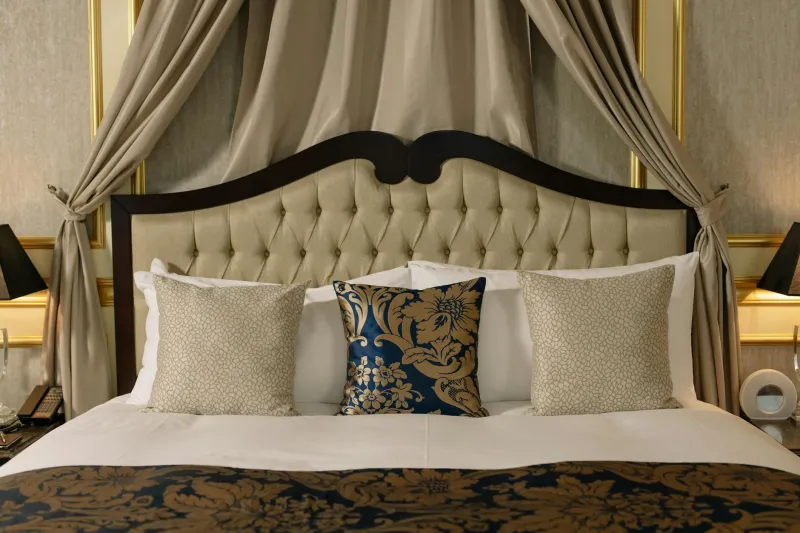
Layers are key: a crisp cotton sheet topped with cashmere throws, velvet cushions against linen headboards, silk curtains paired with textured blinds. Each material serves both functional and psychological purposes, creating a tactile landscape that invites exploration.
British homes can adopt this layering philosophy without breaking budgets. The trick is investing in one genuinely luxurious piece — perhaps a cashmere throw or silk pillowcase — and building around it with more affordable textures that complement rather than compete.
The Science of Controlled Chaos
Peer closely at any beautifully photographed hotel room, and you'll spot something remarkable: strategic imperfection. A throw casually draped over a chair's arm. Books stacked asymmetrically on a side table. A robe hanging just so on a bathroom door.
This 'controlled chaos' is actually highly deliberate, designed to make spaces feel lived-in and approachable rather than museum-like. It's a delicate balance that professional stylists spend years perfecting.
"The moment a space feels too perfect, it becomes intimidating rather than inviting," observes Emma Richardson, whose prop styling work has graced hotels from Bath to the Lake District. "We're always looking for ways to introduce gentle disorder that feels natural rather than contrived."
Bringing Hotel Magic Home
The beauty of hotel bedroom design lies in its scalability. These techniques work whether you're styling a grand Georgian bedroom or a compact Victorian terrace room.
Start with lighting — it's the quickest transformation. Replace overhead fixtures with multiple table and floor lamps. Add dimmer switches to create flexibility throughout the day.
Next, consider your textile story. Layer different textures and weights, but keep to a cohesive colour palette. British bedrooms benefit from the warmth of natural fibres — wool, cotton, linen — that age beautifully and improve with use.
Finally, embrace strategic imperfection. That perfectly made bed might photograph well, but a slightly rumpled duvet with a casually placed throw creates immediate intimacy.
The Ultimate Retreat
Britain's hotel bedroom designers understand something fundamental: the bedroom isn't just where we sleep, it's where we retreat from the world. By borrowing their techniques — layered lighting, thoughtful textiles, and strategic imperfection — any British bedroom can become a sanctuary worthy of a five-star review.
The next time you check into a beautifully designed hotel room, don't just enjoy it — study it. The secrets are hiding in plain sight, waiting to transform your own bedroom from functional space into restorative retreat.