Festival Field to Garden Glory: How Britain's Live Music Stages Are Rewriting Outdoor Design Rules
When the last chord rings out across Worthy Farm and the festival-goers trudge home through the Somerset mud, what remains is more than just trampled grass and discarded glitter. Britain's music festivals leave behind a masterclass in outdoor spatial design that's been hiding in plain sight for decades.
While we've been obsessing over Scandi minimalism and industrial chic indoors, festival production designers have been quietly perfecting the art of creating atmosphere under open skies. Their brief is brutal: transform a field into an immersive world that works equally well at 3pm in blazing sunshine and 11pm in driving rain. The lessons they've learned could revolutionise how we think about our own outdoor spaces.
The Architecture of Anticipation
Walk through the gates at Latitude or End of the Road, and you're immediately struck by something that has nothing to do with the music. It's the way space unfolds around you. Festival designers understand that outdoor environments need what theatre folk call 'reveal moments' – carefully choreographed discoveries that pull you deeper into the experience.
Take Shambala's approach to pathways. Rather than straight lines from A to B, they create meandering routes punctuated by unexpected clearings, each with its own micro-atmosphere. One moment you're walking through a tunnel of fairy lights strung between birch trees, the next you emerge into a clearing dominated by a towering art installation that serves as both landmark and conversation starter.
This translates beautifully to domestic outdoor design. Instead of the traditional British approach of lawn-with-patio-tacked-on, consider creating a journey through your garden. A pergola draped with climbing jasmine becomes your tunnel moment. A fire pit surrounded by weathered oak stumps creates your destination clearing. The key is building anticipation – each turn should promise something worth discovering.
Layered Lighting: Beyond the Fairy Light Cliché
Britain's festivals have moved far beyond the ubiquitous string of fairy lights (though they still have their place). Production designers now work with multiple lighting layers, each serving a different psychological function.
Ground-level lighting creates safety and wayfinding – subtle solar spots that guide feet without overwhelming eyes. Mid-level lighting builds atmosphere – lanterns hung from branches, LED strips tucked under bench seating, fire bowls that cast dancing shadows on surrounding surfaces. High-level lighting provides drama – uplighters that turn mature trees into gothic cathedrals, or colour-wash systems that can transform a simple backdrop into something otherworldly.
The genius lies in how these layers interact. At Bestival's late-night installations, you might find ground lights creating safe passage while uplighters turn the canopy into a green cathedral and mid-level lanterns provide intimate pools of warmth for conversation. It's lighting design that acknowledges how outdoor spaces need to work differently after dark.
Textural Storytelling
Festival designers are masters of using texture to create instant atmosphere. They understand that outdoor spaces lacking the architectural bones of interior rooms need other ways to feel enclosed and intimate. The solution? Layered textures that create psychological boundaries and sensory interest.
At Green Man, the folk stages demonstrate this beautifully. Rough-hewn timber structures are softened with flowing fabrics. Hard metal framework disappears under cascades of ivy and fairy lights. Concrete barriers become invisible behind walls of living willow or bamboo screening.
The principle works just as well in a suburban garden. A stark fence line can be transformed with a combination of vertical planting, weathered timber cladding, and strategically placed mirrors that reflect foliage and sky. Hard paving becomes welcoming when layered with outdoor rugs, scatter cushions in weather-resistant fabrics, and the soft textures of ornamental grasses planted in oversized pots.
Weather-Proofing Without Compromise
British festival designers are the ultimate realists. They know that any outdoor installation must work in a downpour, and this practical constraint has driven some brilliant innovations. Covered areas aren't afterthoughts – they're integral to the design, often becoming the most atmospheric spaces on site.
Consider how Latitude's literary tent creates intimacy through lowered ceilings and soft furnishings, or how Wilderness uses a combination of permanent and temporary canopies to create rooms within rooms. The lesson for domestic design is clear: weather protection shouldn't feel like compromise. A pergola with retractable canopy, a gazebo that doubles as sculpture, or even a simple sail shade can transform how usable your outdoor space becomes.
The Power of Focal Points
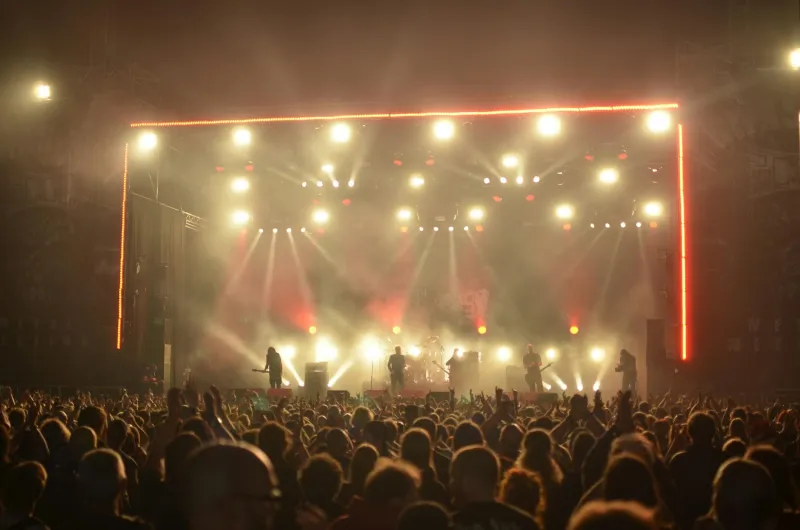
Every successful festival stage has a focal point that draws the eye and anchors the space. Sometimes it's literal – a towering art installation or dramatic backdrop. Sometimes it's more subtle – a carefully curated collection of vintage furniture or an unexpected burst of tropical planting in a British woodland setting.
In domestic terms, this translates to being brave with statement pieces. A sculptural fire bowl becomes your stage centrepiece. An oversized planter filled with architectural plants creates your backdrop. A vintage caravan converted to a garden bar provides your conversation starter. The key is choosing something that feels authentic to your space and lifestyle, not just Instagram-worthy.
Creating Zones Without Walls
Perhaps the most sophisticated trick in the festival designer's playbook is creating distinct zones within open space. At Wilderness, you can move from a jazz lounge area to a folk circle to a dance floor, all within the same field, each feeling completely different despite sharing the same sky.
They achieve this through careful manipulation of sightlines, strategic placement of larger elements like stages or installations, and subtle changes in ground treatment. A patch of artificial grass becomes a picnic zone. Hay bales arranged in a circle create an impromptu amphitheatre. Vintage Persian rugs thrown over straw bales transform a muddy corner into a bohemian lounge.
Your garden can work the same way. Use changes in level, even subtle ones, to create psychological separation between dining and lounging areas. Plant taller specimens to create natural screens between active and quiet zones. Change your ground treatment – decking for dining, gravel for a meditation corner, lawn for games – to signal different uses without building walls.
The Festival Legacy
As another festival season winds down and the temporary structures are packed away, what remains is proof that outdoor spaces can be every bit as atmospheric and emotionally engaging as our most carefully curated interiors. The techniques pioneered in muddy fields across Britain – layered lighting, textural complexity, weather-resilient design, and the art of creating intimacy under open skies – offer a roadmap for anyone ready to take their outdoor living seriously.
The next time you're sipping morning coffee in your garden, ask yourself: what would a festival designer do here? The answer might just transform your patch of British soil into something magical.